
Relays
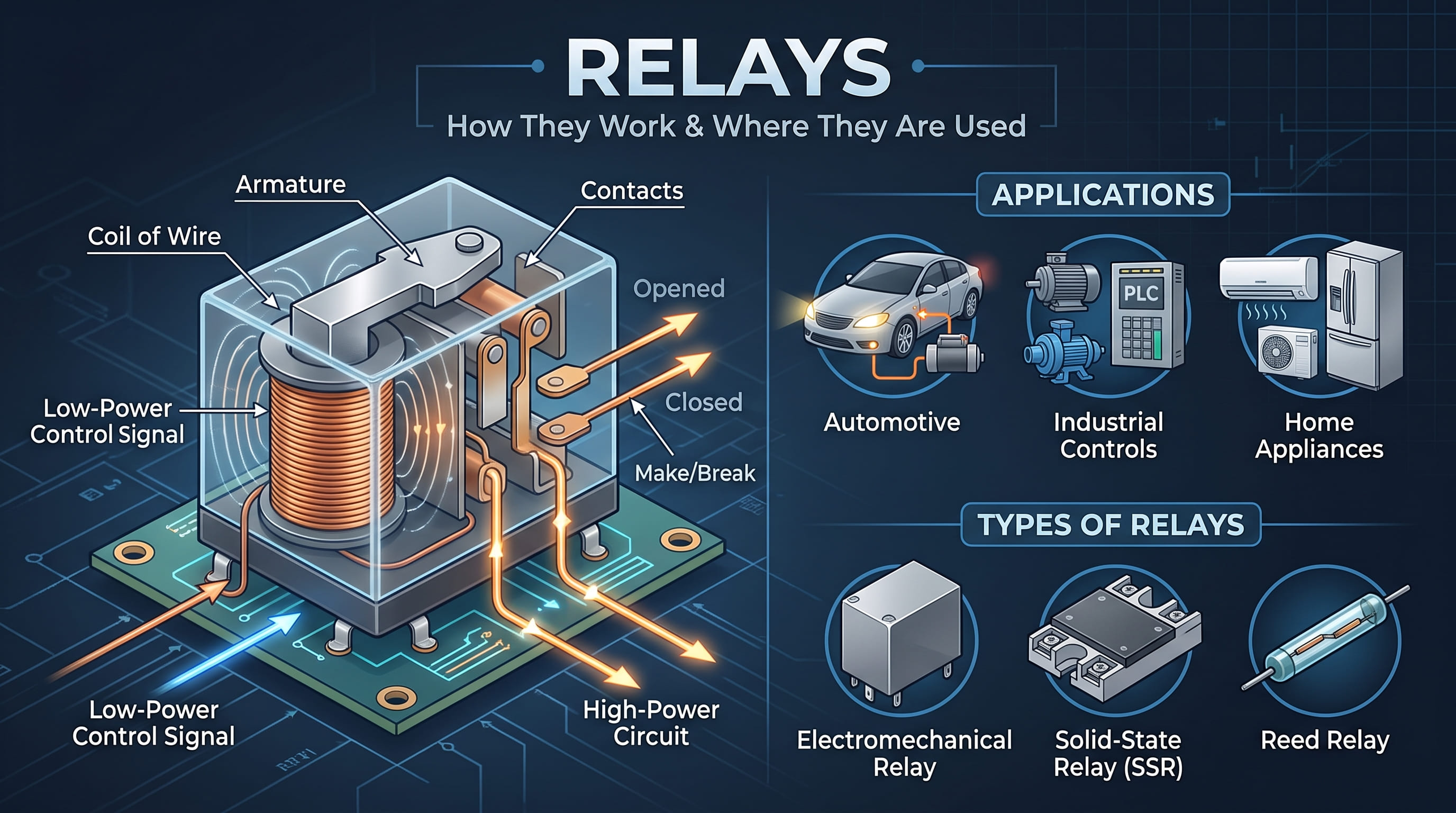
A relay is an electrically operated switch. Relays control an electrical circuit. It consists of a coil of wire, an armature, and a set of contacts. When an electrical current flows through the coil, it creates a magnetic field. Then the field moves the armature and causes the contacts to either make or break an electrical connection.
Applications of Relays
Relays are used in a wide variety of applications, such as automotive systems, industrial controls, and home appliances.
Automobiles: Relays control the electrical systems such as headlight, horn, starter, and fuel pump.
Industrial controls: Relays control motors, pumps, and other equipment.
Home appliances: Relays control the power to various devices such as air conditioners and refrigerators.
Types of Relays
There are several types of relay, such as electromechanical relays, solid-state relays, and reed relays. Electromechanical relays have a mechanical switch. The switch is controlled by an electromagnetic coil. Solid-state relays use semiconductor devices. Therefore they control the switching of the electrical circuit. Reed relays use a small glass tube with a metal reed inside to control the switching of the electrical circuit.
Advantages of Relays
Relays control high-power circuits with a low-power signal. A small switch in a car's interior can be used to control the headlights, which draw a much higher current. Therefore more convenient and safer control of the electrical systems are provided.
Relays are preferred in automation and control systems, such as programmable logic controllers (PLCs) and remote control systems. They switch on or off the power supply of other devices, change the direction of the motor or switch the phase of the electric circuit.