
CAN Protocol
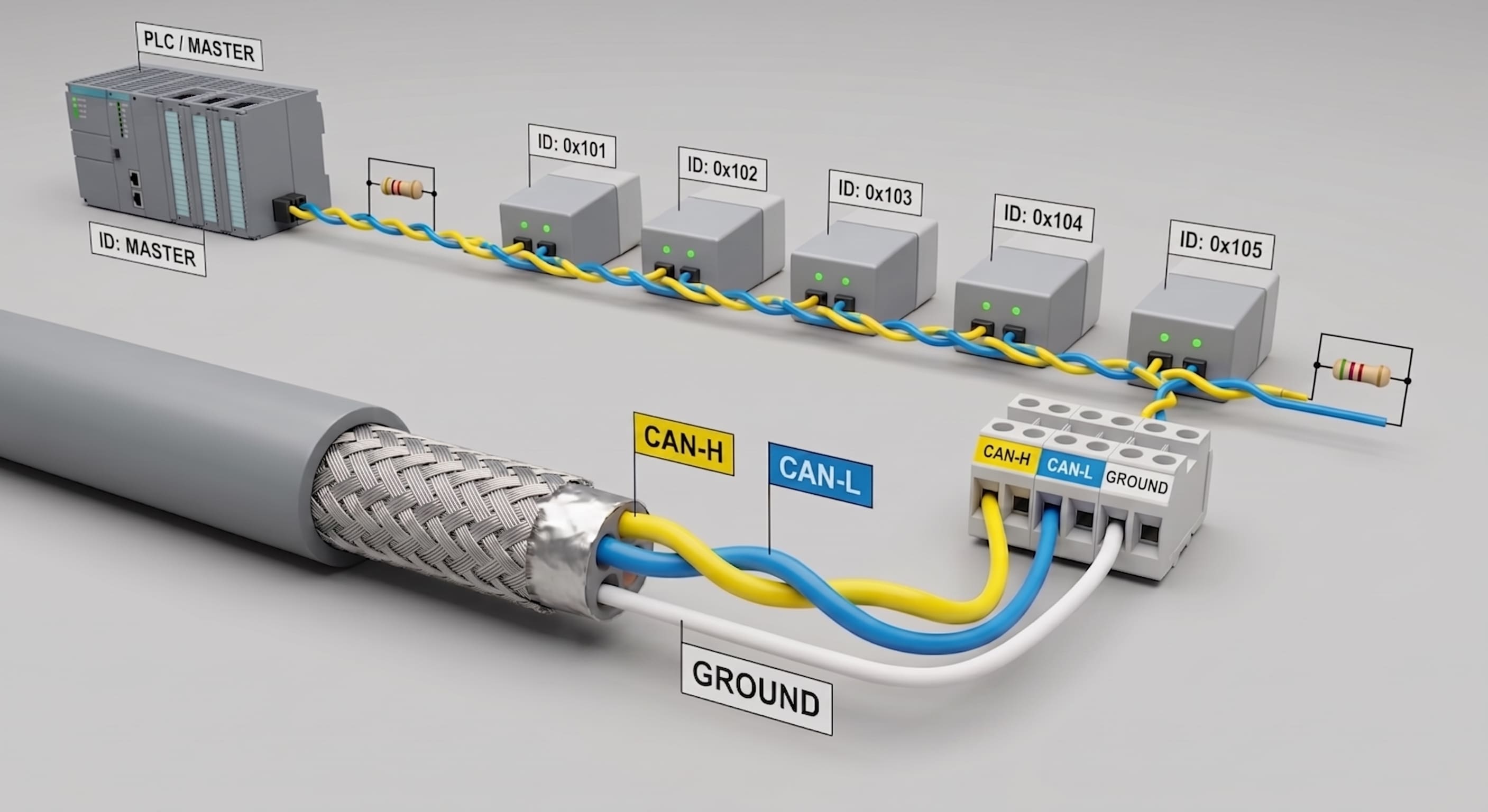
The Controller area Network(CAN communication system) is used in many industrial applications, from aviation to industrial automation, robotics to defense industry. BOSCH has developed the CAN-Bus system to get rid of the excess cable burden in vehicles. The can communication system minimizes cable clutter and weight. In addition to reducing the number of cables, the CAN-Bus system prevents the units on the vehicle from being affected by electrical noise, ensuring safe and uninterrupted operation of the vehicle. The margin of error of the CAN communication system is very low.
The communication line in CAN bus system consists of two communication cables and one ground cable. All devices in the system (node) are connected to CAN-Low and CAN-High cables with two cables. The nodes send the datas via Broadcast method over this line.
The main structure of CAN-Bus messages consists of 3 elements:
ID: It's the identity of the message. Allows the device to understand if the incoming message is related to it.
α: Refers to the data length. Range between 0-7 bytes.
Data
There is a structure in the CAN-Bus system so that priority messages are transmitted. CAN points transmit data and several CAN points can request data simultaneously. Since the communication line in the CAN system is twisted with two wires, the effect of the magnetic field is reduced. Diameter of cable can be selected between 0.34 mm2-0.6 mm2. Line length determine communication speed. As the length increases, the communication speed decreases.
CAN Open
CANopen communication protocol is based on the CAN communication system. The CAN protocol is at the physical layer and data link layer in the OSI model. The CANopen protocol covers the network, transport, session, presentation and application layers above these layers. The CANopen protocol offers the manufacturer a flexible structure. For this reason, each manufacturer makes its own unique definitions. These definitions are not shared with the end user to protect confidentiality and customer dependency.
Master-Slave Devices
The task of MASTER:
Start/Stop CANOPEN Communication
Switch off/on slave devices on the line
Making adjustments of slave devices
To check the operating status of slave devices
Sample of the Master devices:
ECU (Electronic Control Unit): In cars, it processes data, makes decisions and controls other devices.
PLC: Provides control of other devices in industrial applications.
The task of SLAVE:
MASTER device requests data from SLAVE device. The SLAVE device transmits the requested data to the MASTER device.
It connects lighting devices, motor control devices, sensors, input-output n-modules, control panel devices to CAN Open communication line.
The node is each connection point on the communication line. Each node (device) in the CAN Open communication line must have an ID identification number. There are 32 devices on the Low-speed CAN line and 110 devices on the High-speed CAN line.
CAN-open communication speed decreases as cable length increases. All devices on the line must operate with the same baud-rate. Baud-rate is the number of pulses per second produced or received by the devices on the line.