
Ethernet Protocol
Who invented Ethernet?
Ethernet was created in 1973 by Xerox PARC engineers Robert Metcalfe and David Boggs. It was inspired by the ALOHAnet project at the University of Hawaii. In its early stages, it was quite primitive by today's standards, reaching only 2.94 Mbps in raw speed. The general public outside the university would not see Ethernet until 1980. Metcalfe, who had left the company to found 3Com, convinced several major industry players, including Digital Equipment Corporation (DEC), Intel and Xerox, to work with 3Com to make Ethernet a unified standard.Under this agreement, Xerox removed the trademarked name Ethernet and allowed any company to use Ethernet with its products. The bandwidth and transmission speed were also increased to 10 Mbps, which was more than enough to handle most networking tasks with the space available at the time. All this helped this protocol become the dominant standard worldwide.
What is Ethernet?
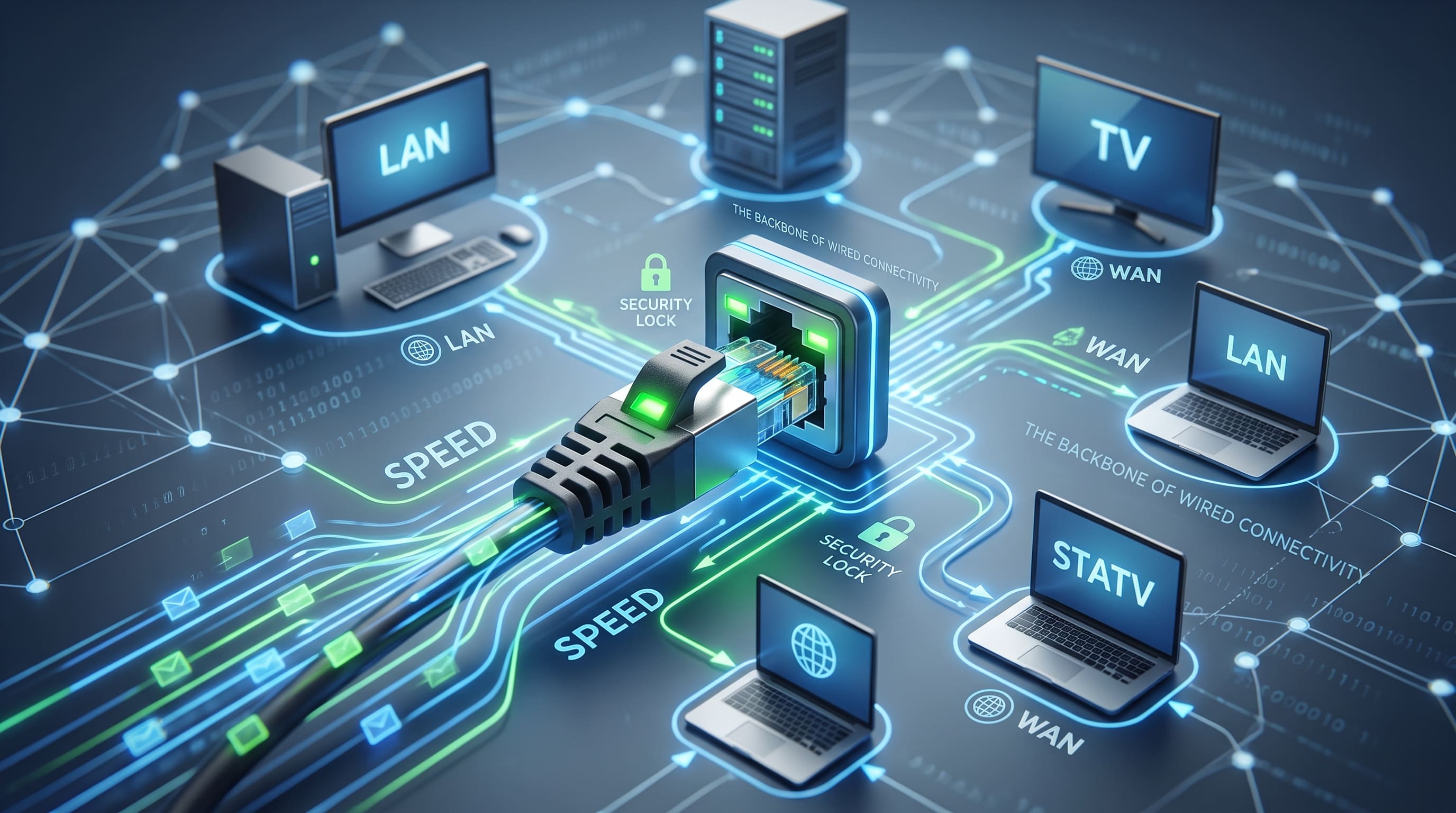
Ethernet is the traditional technology used to connect devices in a wired local area network (LAN) or wide area network (WAN). It allows devices to communicate with each other through a protocol, which is a set of rules or a common network language.
This describes how network devices format and transmit data so that other devices on the same LAN or campus network can recognize, receive, and process information. An Ethernet cable is the physical, enclosed cable over which data travels.
Connected devices that use a cable to access a geographically localized network rather than a wireless connection are most likely to use it. End users ranging from businesses to gamers rely on the advantages of this connectivity, including reliability and security.
Compared to wireless LAN (WLAN) technology, It is typically less vulnerable to outages. It can also offer more network security and control than wireless technology, as devices need to be connected using physical cables. This makes it harder for outsiders to access network data or seize bandwidth for unapproved devices.
How Does It Work?
Ethernet uses the multiple network access (CSMA/CD) method for data transfer. This method is as follows:1. Data Packetization: A device that wants to perform a transaction generates a data packet and sends it to other devices on the network.2. Cable Check: The device checks if the network cable is available. If the cable is present, the data transfer continues.3. Data Transfer Over Cable: The device sends the data packet over the network cable to other devices.4. Packet Reception: The other devices receive the data packet and check its contents. If the packet has reached the correct destination, its contents are made available.5. Country Off: If the cable is not available, the device waits and resumes data transfer when the cable is available.
This protocol sends data in packets and each device on the network ensures that the data packets go to the correct destination and can be accessed by many devices at the same time. Ethernet allows data packets to be transferred securely and quickly and makes it easier to transfer data between networks.
Advantages
1. Speed: The speed offered by Ethernet is much higher compared to a wireless connection. This is because Ethernet provides a one-to-one connection. As a result, speeds of 10Gbps or sometimes 100Gbps are easily achievable.2. Efficiency: Ethernet cable like Cat6 consumes even lower amount of power than a wifi connection. Hence, this type of ethernet cable is considered to be the most power efficient.3. Good data transfer quality: Since it is strong against noise, the quality of information transferred will not degrade.4. Security: An Ethernet connection provides a higher level of security than a wireless connection. An Ethernet connection usually provides control over who uses the network and therefore any information is not easily available to hackers.5. Relatively low cost: We don't need a lot of cost to build an ethernet. It is really cheap.6. Reliability: Ethernet connections are one of the most reliable connections due to the fact that there are no or zero interruptions from radio frequencies. As a result, there are fewer disconnections, less slowdowns and no bandwidth shortages.
Disadvantages
1. Limited data transfer speed: Ethernet is limited in terms of data transfer speed compared to other network technologies and other technologies must be used for large data transfers.2. Cable requirement: Ethernet requires physical connection via network cables and is not suitable for wireless networks.3. Cable length limit: Ethernet implies that the length of the network cable is limited and other technologies must be used for long distances.4. Low security: It has a lower level of security than other network technologies in terms of data security and other technologies should be used for more secure networks.